
August 8, 2026
Perfumed oil: composition, longevity and precautions
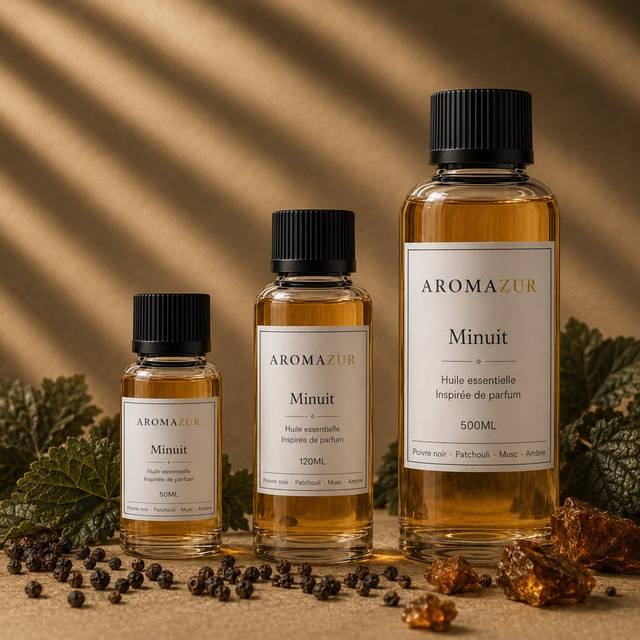
It comes in a small amber bottle, smells strong, and goes in a diffuser. Yet, a fragrance oil is not like other products: it is a composition, created for a specific use. Here is what it is, why it lasts, and the rules to follow to use it safely.
A fragrance oil is a composition
A fragrance oil is created by a perfumer, like a skin fragrance. It combines selected raw materials and synthetic molecules to achieve a precise accord, with an olfactory pyramid: top notes that give the first impression, a heart that settles in, and a base that lasts.
Three consequences.
It is reproducible. The bottle you buy again in two years will smell exactly like the one you have today. This is what allows a signature to become recognizable — a hotel cannot have its lobby smell different from one order to the next; that is the spirit of our hotel fragrance for the home.
Its palette is endless. Leather, ambergris, musk, praline, marine notes, and black fig only exist through perfumery: it is the perfumer's work that composes them.
Its longevity is carefully crafted. A citrus accord created by a perfumer lasts all day because it is built on base molecules that hold the light notes.
Why we chose fragrance oil for home fragrance
A skin fragrance lasts a few hours on someone, in a tiny volume and at a constant temperature. A fragrance for a space must last all day in an open area, with drafts and people coming and going. These are two different professions.
Our thirty-two signatures are composed in Grasse for the latter use. They are highly concentrated, without alcohol, without water, and without a carrier that would evaporate before the fragrance — this is what allows a 20 ml bottle to last for weeks in cold nebulization.
We claim no therapeutic effects. Our products scent a space. They do not treat anything, do not relax you more than a pleasant smell relaxes, and do not replace any treatment.
The origin of an ingredient and safety: two different questions
A simple idea is circulating: that what comes from a plant is safe, while what is synthetic is suspicious. In perfumery, this idea is false, and it is useful to know why.
The substances that most frequently cause allergies in perfumery are mostly of plant origin. Linalool, limonene, geraniol, citral, and eugenol — which European regulations require to be declared on labels — are found in lavender, lemon, rose, or cloves. A plant-based ingredient sometimes contains far more than a synthetic molecule designed in a laboratory, whose purity is precisely controlled.
The raw materials in a fragrance oil are governed by the professional standards of the IFRA, which set usage limits for each ingredient according to its use. The relevant criterion is not origin, but compliance with these limits.
Usage precautions
These rules apply to any fragrance oil used in a diffuser.
Never apply to the skin and never ingest. Our oils are formulated for the air, not for the body. They are neither tested nor intended for skin contact.
Keep out of reach of children. The risk is not diffusion, but the accidental ingestion of a bottle left within reach.
Diffuse in a ventilated room, never in a closed space for an extended period. A fragrance, even a pleasant one, is made to be perceived intermittently. All our devices operate in cycles, with pauses.
Leave a door open if there are animals. A cat or dog must always be able to leave the room. Cats in particular metabolize certain aromatic compounds poorly; the precautionary principle dictates that you should never diffuse in a closed room where an animal cannot move away. The same applies to birds, whose respiratory system is very sensitive.
In case of pregnancy, asthma, or a history of allergies, ask a healthcare professional for advice before diffusing anything, for an extended period, in a living space.
How to read a label
Three quick checks are enough to make a difference in the store.
A fragrance oil bears a composition name and states its intended use: diffusion, home fragrance.
It must display the declarable allergens and the applicable hazard pictograms. A label that displays nothing at all is not reassuring; it is simply non-compliant.
Finally, check that the oil is designed for your device (see the diffuser guide by area): an oil for cold nebulization must be pure, without water or alcohol, so as not to clog the nozzle.
So, which one for your home?
If you are looking to give an olfactory identity to a space — a living room you recognize upon entering, a shop you remember, a hotel room that makes you want to return — you need a fragrance oil for home fragrance, and it must be designed for diffusion. See also how long a bottle of fragrance oil lasts.
Other questions? Our frequently asked questions cover the essentials, and we will answer you within 24 business hours at contact@aromazur.fr.